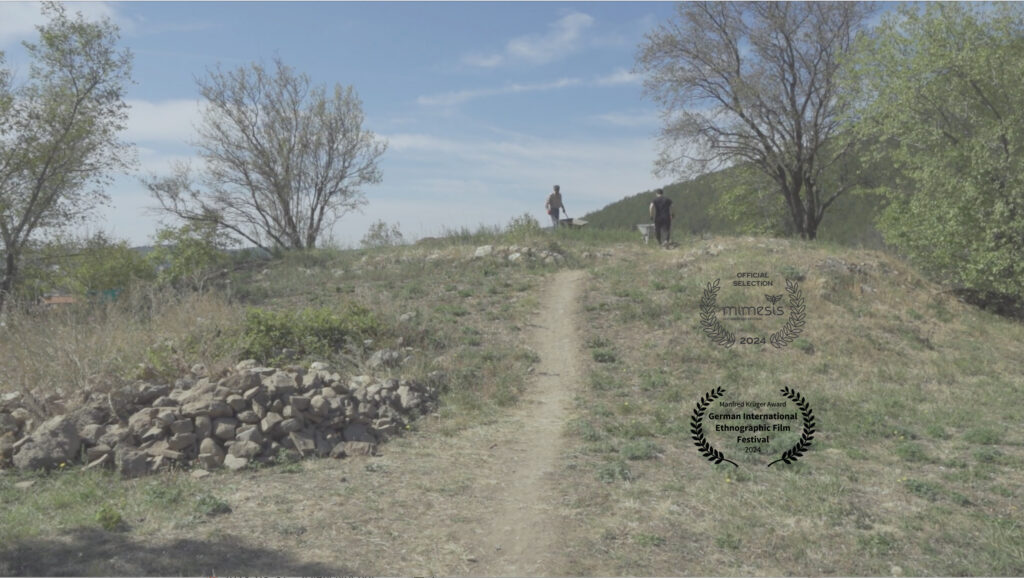
COUPLE MORE SHOVELS FOR A FEW MORE LEVS
42 min, 1080p, 2024
Director/Producer/Editor: Pauline Shongov
Couple More Shovels for a Few More Levs features a group of workers at an
archaeological site in the Sub-Balkan region of eastern Bulgaria whose
confessions to the camera explore the conditions of contemporary life in a
country shaped by over thirty years of lethargic political transition. Taking a
cinema verité approach, the film observes acts of digging into the ground, into
the past, and through personal woes as they bring to surface unspoken desires,
resentment, frustrations, hope, nostalgia, and resignation. Following a cast of
characters that share the trials and tribulations of their day-to-day life, the film
intimately paints a portrait of the country. At a time when the Bulgarian
currency lev will soon change to the euro, the vestiges of history come to light
in the presence of a contested cultural identity.
Screenings:
2024 – Mimesis Documentary Festival (Boulder, CO)
2024 – German International Ethnographic Film Festival (Göttingen, DE)
– Manfred Krüger Award
2023 – Regional Historical Museum of Sliven (Sliven, BG)
Selections:
2024 – Visions du Reel Market
2023 – Ji.hlava New Visions Market
It takes a bit of time to begin to understand what is happening in this film. The opening shot, extended for nearly two
minutes without a cut, reveals hands deep in dirt, figures crouching close to the ground amidst a backdrop of sawing
and banging and crushing noises. As the larger physical setting is gradually revealed, we come to understand that this
is an archaeological site on the outskirts of a Bulgarian city, where a crew of mostly male, chain-smoking, pension-aged
laborers are working to extract cultural artefacts long buried in the soil. We follow their bodily movements as they chip
away at the earth, turn over rocks, haul cartloads of dirt to a steep mound at the edge of the site. The camera drifts
through this landscape, animated by the living, breathing motion of the human hand and eye behind it. We overhear bits
of passing conversation, jokes and gossip—about people’s relationship troubles, their voting habits, their uses of technology.
We overhear about meagre salaries, ill family members at home, construction work in a nearby town, how many relatives are
living abroad. The snakes or rats that might be living or hiding behind the stump of a tree. An acquaintance renowned for his
ability to consume 30 meatballs in a single meal. We never find out exactly who these workers are or what specifically they
are looking for, but this is not the point of the film. There is one moment when a man uncovers a bit of glass, which he believes
might be part of a bracelet, and he tells his compatriot to keep digging, shovel by shovel, because ‘that happens to be the
work of archaeology…to unearth, not just to dig’. It also happens to be the work of this rich, multisensory film: slow and
careful looking, focused perseverance and a commitment to sift through the rubble of life to catch a glimpse of
whatever treasure might come to the surface as the interactions and events unfold.
—Journal of Anthropological Films, Vol 10, No. 1, 2026
All three judges agreed that this film was remarkably shot, and that the camera-work reflected the observational and
responsive nature of a phenomenological or sensorial style of filmmaking. What initially may have begun as an exploration
of archaeological practices evolves into a nuanced portrayal of the men that have been hired to excavate the site. Their
repetitive gestures transform into an unpassionate “choreography” of moving dust, deftly captured by the camera amidst
the backdrop of the excavation. Humble yet dynamic, the camera’s attentive explorative framing enables events to unfold
freely and gives the viewer the opportunity to develop an interest in an otherwise perhaps dull space of hard labour. The
camera breathes life into the static setting, fostering a relational aesthetics that flourishes alongside the protagonists,
who are reflecting more and more freely about personal and social relations, aspirations and dashed promises, the
meanings of the past and a blocked future in post-socialist Bulgaria. We felt that the film, through its camerawork
exposes an ethnographic sensitivity that can make us find relevance and interest in any situation we might encounter.
—GIEFF jurors (Metje Postma, Rosella Ragazzi, and Michael Schönhuth)